
 by
by 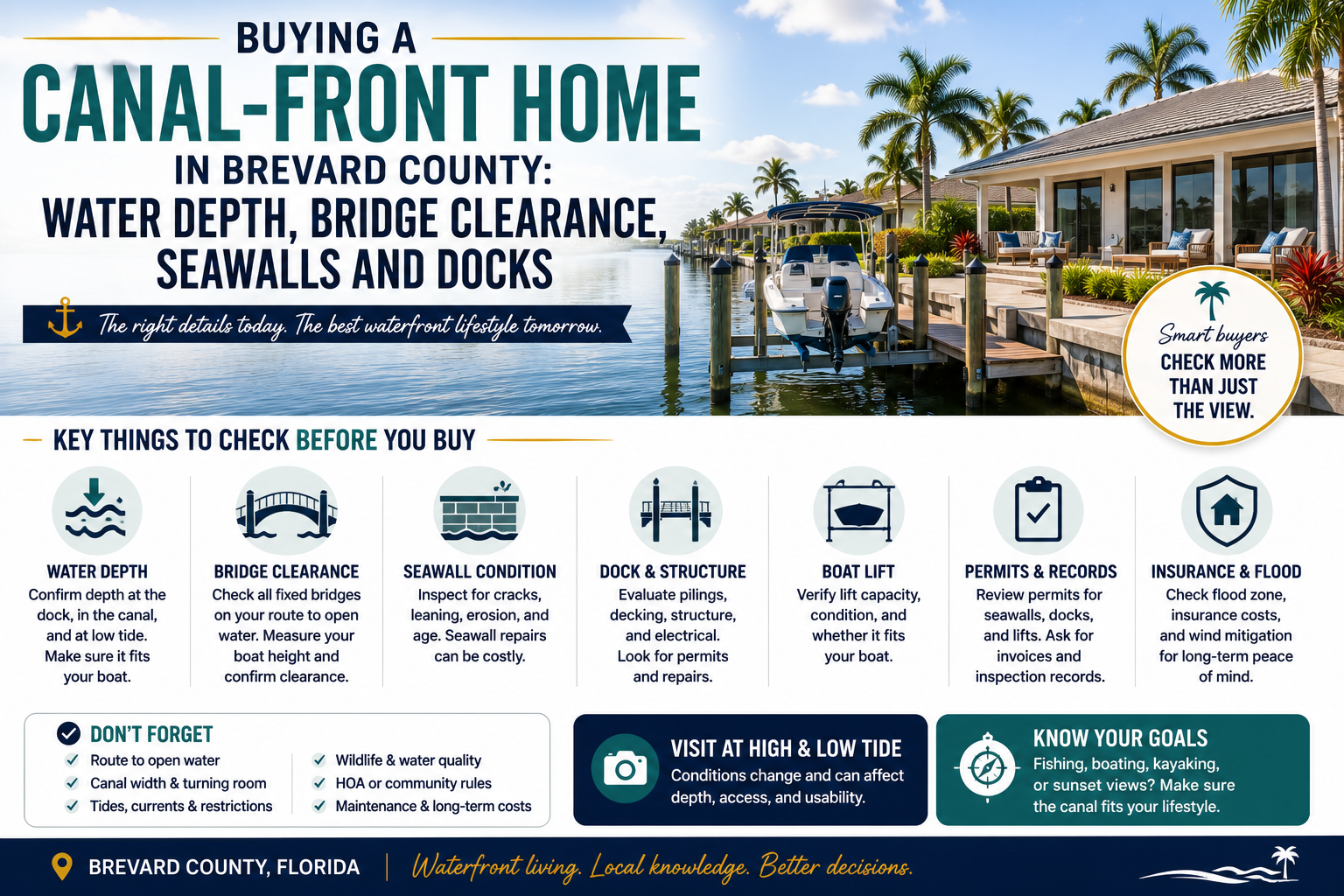
Buying a canal-front home in Brevard County can be an incredible lifestyle move, especially if you love boating, fishing, kayaking, paddleboarding, wildlife, or sunset views from your backyard. But before you fall in love with the water view, you need to understand what the canal can actually do for your lifestyle. Water depth, bridge clearance, seawall condition, dock condition, boat-lift capacity, permits, insurance, and long-term maintenance can all affect whether the home is a smart purchase.
A canal-front home is not just a house with a view. It is a property with a marine component, and that marine component needs its own due diligence.
Quick Answer
Before buying a canal-front home in Brevard County, you should check:
- Actual water depth at the dock
- Depth at low tide or lower water conditions
- Bridge clearance between the home and open water
- Fixed bridges, low bridges, railroad bridges, or overhead obstructions
- Canal width and turning room
- Seawall age, material, condition, and repair history
- Dock age, structure, decking, pilings, and permits
- Boat-lift capacity and condition
- Whether the canal is navigable for your boat
- Flood zone, insurance, elevation, and storm exposure
- Permits for seawalls, docks, boat lifts, and past marine work
- HOA or community restrictions, if applicable
The most important question is not simply, “Is it waterfront?” The better question is, “Can this waterfront property support the way I actually want to use the water?”
Canal-Front Buyer Checklist
| What to Check | Why It Matters |
|---|---|
| Water depth | Determines whether your boat can safely access the canal |
| Low-tide depth | A canal may look fine at high water but be too shallow at other times |
| Bridge clearance | Your boat may not fit under fixed bridges or low crossings |
| Route to open water | Some canals have multiple bridges, narrow turns, or limited access |
| Seawall condition | Repairs or replacement can be expensive and affect property value |
| Dock condition | Docks require structural review, maintenance, and sometimes permits |
| Boat lift | Capacity, age, electrical condition, and fit for your boat matter |
| Canal width | Wider canals may be easier for turning, docking, and boat handling |
| Permits | Prior marine work should be reviewed and documented when possible |
| Insurance and flood zone | Waterfront ownership can affect carrying costs and buyer comfort |
| Resale appeal | Better water access can improve future buyer demand |
What Counts as a Canal-Front Home in Brevard County?
A canal-front home is a property located on a manmade or natural waterway that may offer private or semi-private water access from the backyard. In Brevard County, canal-front homes can be found in areas such as Merritt Island, Cocoa Beach, Satellite Beach, Indian Harbour Beach, Melbourne Beach, Palm Bay, South Patrick Shores, Sykes Creek, Grand Canal, Turkey Creek, and neighborhoods connected to the Indian River Lagoon or Banana River.
Some canal-front homes are ideal for boating. Others are better suited for kayaking, paddleboarding, fishing, or simply enjoying the water view.
That distinction matters.
A listing may say “canal-front,” “waterfront,” or “navigable canal,” but buyers should still verify exactly what type of water access the property offers.
The Biggest Mistake Canal-Front Buyers Make
The biggest mistake buyers make is assuming that all canal-front homes offer the same water access.
They do not.
Two homes may both be on canals, but one may allow access for a larger boat while the other may only work for a small skiff, kayak, paddleboard, or shallow-draft boat. One may have quick access to the Banana River or Indian River Lagoon, while another may require navigating shallow water, narrow turns, bridges, or idle-speed zones.
Before buying, you need to verify whether the canal fits your boat, your lifestyle, and your expectations.
Water Depth: Why It Matters
Water depth is one of the most important things to verify before buying a canal-front home.
If you own a boat, you need to know whether the water is deep enough at the dock, through the canal, and along the route to open water. A canal may look beautiful, but if the water is too shallow for your boat, the home may not work for your intended use.
Ask about:
- Depth at the dock
- Depth in the canal
- Depth at low tide or lower water conditions
- Depth along the route to open water
- Whether the canal has been dredged
- Whether neighbors have similar boats
- Whether boats commonly get stuck or bottom out
- Whether the canal has sandbars, silt buildup, or vegetation issues
Do not rely only on what the water looks like from the backyard. Verify it.
Know Your Boat Before You Shop
If you are buying a canal-front home because you own or plan to own a boat, you need to know your boat’s requirements before choosing the home.
Important measurements include:
- Draft
- Beam
- Overall length
- Height from waterline to highest fixed point
- Whether antennas, T-tops, towers, or hardtops fold down
- Needed lift capacity
- Turning radius
- Whether the boat needs deep water
- Whether the boat is better suited for shallow canals
A buyer with a flats boat, pontoon, center console, sailboat, cabin cruiser, or larger offshore boat may have very different needs.
Bring your boat specifications into the home search early. It can save you from falling in love with a property that does not actually work for your boat.
Bridge Clearance: Do Not Guess
Bridge clearance is one of the most overlooked issues in canal-front home buying.
A home may have enough water depth, but your boat may not fit under the bridges between the home and open water. This is especially important for boats with T-tops, towers, radar arches, fixed antennas, hardtops, or sailboat masts.
Before buying, identify:
- Every bridge between the home and open water
- Whether each bridge is fixed or movable
- Vertical clearance
- Horizontal clearance
- Clearance at high water
- Whether your boat can safely pass
- Whether any overhead lines or other obstructions exist
- Whether your route changes during different water conditions
A few inches can matter. Always verify with reliable navigation resources and local marine professionals.
Route to Open Water
Canal-front buyers should look beyond the backyard and study the full route to the water they want to use.
Ask:
- How long does it take to reach the Indian River Lagoon, Banana River, Intracoastal Waterway, or open boating areas?
- Are there idle-speed or manatee zones?
- Are there narrow turns?
- Are there shallow sections?
- Are there bridges?
- Are there locks or restricted areas?
- Is the route practical for everyday boating?
- Can you navigate safely in wind, current, or lower water?
- Is the route enjoyable or frustrating?
The home may look perfect from the dock, but the boating route is part of the purchase.
Canal Width and Turning Room
Canal width affects how easy it is to dock, turn, and maneuver your boat.
Some canals are wide and comfortable. Others are narrow, especially when neighboring docks, lifts, moored boats, or vegetation reduce usable space.
Consider:
- Width of the canal
- Distance to the opposite seawall
- Neighboring docks and lifts
- Whether larger boats can turn around
- Wind direction
- Current
- Boat traffic
- Room for backing in or pulling out
- Whether your boat lift location makes sense
If you are not an experienced boater, this is an area where a marine professional or experienced local boater can be very helpful.
Seawalls: What Buyers Need to Know
The seawall is one of the most important components of a canal-front property.
A seawall helps retain the land and protect the property edge from erosion, water movement, and soil loss. If the seawall is failing, repairs can be significant and should be understood before closing.
Before buying, ask:
- What material is the seawall?
- How old is it?
- Has it been repaired?
- Was it permitted?
- Are there invoices or warranties?
- Are there cracks, bowing, leaning, or separation?
- Is soil washing out behind the wall?
- Are there sinkholes or depressions near the wall?
- Are the cap and tiebacks in good condition?
- Are neighboring seawalls in similar condition?
Do not assume a seawall is fine because it looks acceptable from a distance. Have it evaluated if there are any concerns.
Signs of Possible Seawall Problems
Watch for:
- Cracks in the seawall
- Leaning or bowing
- Rust stains
- Missing panels
- Gaps between sections
- Soil loss behind the wall
- Depressions in the yard
- Water intrusion behind the wall
- Damaged cap
- Uneven pavers or settling near the water
- Exposed tiebacks
- Excessive vegetation growth through the wall
- Neighboring seawall failures
A seawall issue does not automatically mean you should walk away, but it does mean you need estimates, documentation, and a negotiation strategy.
Docks: More Than a Pretty Sitting Area
A dock can add major lifestyle value to a canal-front home, but it also needs to be reviewed carefully.
A dock may be used for boating, fishing, kayaking, paddleboarding, entertaining, or simply enjoying the water. But if it is deteriorated or improperly built, it can become a safety and maintenance issue.
Review:
- Pilings
- Decking
- Framing
- Fasteners
- Handrails
- Electrical components
- Water supply, if present
- Lighting
- Ladder
- Fish-cleaning station, if present
- Dock age
- Permits
- Repairs or replacements
- Whether the dock fits your intended use
If you plan to use the dock for boating, make sure it is functional for the boat you have or plan to buy.
Boat Lifts: Capacity and Condition Matter
A boat lift can be a major advantage, but it must fit your boat.
Do not assume an existing lift will work for your needs.
Check:
- Lift capacity
- Boat weight
- Beam compatibility
- Bunk configuration
- Motor condition
- Cable condition
- Electrical condition
- Remote operation
- Age of the lift
- Maintenance records
- Permit history
- Whether the lift is positioned correctly
- Whether your boat can enter and exit safely
A boat lift that is too small, poorly maintained, or improperly positioned may need repairs, reconfiguration, or replacement.
Permits for Seawalls, Docks, and Boat Lifts
Marine improvements often require permits or regulatory review. This can include docks, seawalls, boat lifts, repairs, replacements, and certain shoreline work.
Before buying, ask for:
- Dock permits
- Seawall permits
- Boat-lift permits
- Repair permits
- Contractor invoices
- Final inspection records
- DEP or environmental documentation, if applicable
- HOA or community approvals, if applicable
- Survey or site plan showing marine improvements
Permit requirements can vary based on location, water body, scope of work, environmental conditions, and whether the property is in unincorporated Brevard County or inside a city.
Do not assume that an existing dock, seawall, or boat lift was properly permitted. Verify when possible.
Flood Zone, Elevation, and Insurance
Canal-front homes may have additional insurance and flood considerations.
Before buying, review:
- FEMA flood zone
- Elevation information
- Flood insurance quote
- Homeowners insurance quote
- Wind mitigation report
- Roof age and condition
- Openings and hurricane protection
- Prior water intrusion
- Drainage around the home
- Finished-floor elevation, when available
- Garage and lower-level areas
- Pool and exterior structures
- Dock and seawall coverage questions
Waterfront ownership can be wonderful, but buyers should understand the carrying costs before the inspection period ends.
Waterfront Maintenance Costs
A canal-front home can have higher maintenance needs than a non-waterfront home.
Possible costs include:
- Seawall repairs
- Dock repairs
- Boat-lift service
- Electrical service to dock or lift
- Piling replacement
- Decking replacement
- Storm cleanup
- Mangrove or vegetation management, when applicable
- Erosion control
- Drainage repairs
- Pool and screen-enclosure maintenance
- Exterior painting and salt-air wear
- Insurance and flood coverage
The lifestyle can be worth it, but it should fit your budget.
Water Quality, Wildlife, and Everyday Use
Canal-front living in Brevard County is about more than boating.
Many buyers love seeing dolphins, manatees, birds, fish, and beautiful sunsets. Others want easy access for kayaks and paddleboards. Some want privacy, while others want active boating access.
Ask yourself how you want to use the water:
- Do you want to keep a boat?
- Do you want a lift?
- Do you want to kayak or paddleboard?
- Do you want to fish from the dock?
- Do you want sunset views?
- Do you want privacy?
- Do you want quick access to open water?
- Do you care about canal traffic?
- Do you prefer wide water or a protected canal?
The best canal-front home is the one that matches your actual lifestyle.
Location Matters: Not All Brevard Canals Are the Same
Canal-front homes in Brevard County vary significantly by area.
Merritt Island
Merritt Island has many waterfront and canal-front neighborhoods, including areas with access to the Banana River, Indian River, Sykes Creek, and nearby waterways. Buyers should pay close attention to water access, bridge clearance, seawall condition, and boating route.
Cocoa Beach and Cape Canaveral
Cocoa Beach and Cape Canaveral canal homes may appeal to buyers who want a coastal lifestyle, boating, surf culture, restaurants, and proximity to Port Canaveral. Bridge clearance, short-term rental rules, and waterfront maintenance should be reviewed carefully.
Satellite Beach and Indian Harbour Beach
These areas can offer canal and water-adjacent homes with strong beachside lifestyle appeal. Buyers often value proximity to the beach, parks, Patrick Space Force Base, and local amenities.
Melbourne Beach and Indialantic
Canal-front options are more limited compared with some other parts of the county, but waterfront and lagoon-adjacent properties can be highly desirable. Buyers should carefully review access, seawalls, docks, flood zones, and insurance.
Palm Bay and Turkey Creek Area
Some waterfront and canal-adjacent properties may offer kayaking, fishing, or small-boat potential, but buyers should verify navigability, depth, and any restrictions before assuming boating access.
What I Tell Buyers Locally
When buyers ask me about canal-front homes, I always tell them to define the lifestyle first.
If you want to look at the water and enjoy the view, your needs may be different from someone who wants to keep a 28-foot center console behind the house. If you want to kayak and paddleboard, shallow water may not bother you. If you want ocean access, bridge clearance and route matter much more.
A canal-front property can be a dream home, but only if the water access matches your expectations.
The smartest buyers verify before they buy.
Questions to Ask Before Buying a Canal-Front Home
Before making an offer or during your inspection period, ask:
- What is the water depth at the dock?
- What is the water depth at low tide or lower water?
- What is the route to open water?
- Are there bridges between the home and open water?
- What is the lowest bridge clearance on the route?
- Will my boat fit under all bridges?
- Is the canal wide enough for my boat?
- Is the seawall original, repaired, or replaced?
- Are there seawall permits or repair invoices?
- What is the dock condition?
- Was the dock permitted?
- What is the boat-lift capacity?
- Does the lift fit my boat?
- Are there HOA restrictions?
- What are the flood and insurance costs?
- Are there known drainage or erosion issues?
- Are there environmental restrictions?
- What maintenance should I expect over the next five years?
These questions can prevent expensive surprises.
Should You Get a Marine Contractor Inspection?
Yes, if the property has a seawall, dock, boat lift, or visible marine improvements.
A general home inspector may not fully evaluate marine structures. A marine contractor, seawall specialist, dock contractor, or boat-lift professional may provide better insight into condition, remaining life, repair needs, and estimated costs.
Consider separate inspections for:
- Seawall
- Dock
- Boat lift
- Electrical to dock or lift
- Drainage near the seawall
- Pool and patio areas near the canal
- Retaining walls or shoreline stabilization
Specialized inspections can help you negotiate with facts.
How Canal Features Affect Value
Canal-front value is influenced by much more than the house itself.
Important value factors include:
- Navigability
- Water depth
- Bridge clearance
- Distance to open water
- Canal width
- View quality
- Seawall condition
- Dock condition
- Boat lift
- Outdoor living space
- Privacy
- Flood zone
- Insurance costs
- Orientation and sunset views
- Neighborhood demand
- Resale buyer pool
A canal-front home with strong boating access may appeal to a different buyer than a canal-front home that is primarily for views and paddleboarding. Both can be valuable, but the pricing should reflect the actual water utility.
Red Flags to Watch For
Be cautious if you notice:
- The listing says “navigable” but no one can confirm water depth
- The seller does not know bridge clearance
- The seawall is leaning, cracked, or separating
- There is soil loss near the seawall
- The dock feels soft or unstable
- The boat lift has no known capacity
- Electrical near the water looks unsafe
- No permits can be found for major marine work
- The canal appears too shallow for the listed use
- Neighboring properties have seawall failures
- The home is priced like premium boating access but only offers limited water use
Red flags do not always mean you should walk away, but they do mean you should investigate further.
Negotiating a Canal-Front Home
If inspections reveal seawall, dock, lift, depth, or access concerns, negotiate based on documentation.
Useful negotiation tools include:
- Marine contractor estimate
- Seawall inspection report
- Dock inspection report
- Boat-lift service estimate
- Insurance quote
- Flood insurance quote
- Survey
- Permit records
- Photos or video
- Comparable sales with better or worse water access
The strongest negotiations are based on facts, not assumptions.
Is a Canal-Front Home Worth It?
A canal-front home can absolutely be worth it if the location, water access, condition, and ownership costs fit your goals.
It may be worth it if:
- You will use the water regularly
- The canal fits your boat or water lifestyle
- The seawall, dock, and lift are in good condition
- You understand the insurance and flood costs
- The price reflects the condition
- The home has strong resale appeal
- The lifestyle matters to you
It may not be worth it if the water access does not work for your needs, the marine repairs are too expensive, or the property is priced higher than the actual canal utility supports.
Best Answer: What Should You Check Before Buying a Canal-Front Home?
Before buying a canal-front home in Brevard County, verify the water depth, bridge clearance, route to open water, seawall condition, dock condition, boat-lift capacity, permits, flood zone, insurance costs, and long-term maintenance needs.
Do not assume a canal-front home is automatically boat-friendly. Some canals are excellent for boating, while others are better for kayaks, paddleboards, fishing, or views.
The right canal-front home should fit both your house needs and your water lifestyle.
Final Thoughts
Canal-front homes in Brevard County offer a lifestyle that many buyers dream about. The ability to walk into your backyard, see the water, launch a kayak, fish from the dock, or take the boat out can make everyday life feel like a vacation.
But waterfront ownership requires careful due diligence.
Before buying, make sure the canal, seawall, dock, lift, permits, insurance, and maintenance costs all make sense. When you understand those details upfront, you can make a smarter decision and avoid surprises after closing.
A canal-front home can be an incredible investment in lifestyle, but only when the water access truly matches the way you want to live.
FAQ: Buying a Canal-Front Home in Brevard County
What should I check before buying a canal-front home in Brevard County?
You should check water depth, bridge clearance, route to open water, seawall condition, dock condition, boat-lift capacity, permits, flood zone, insurance costs, and maintenance needs.
Does canal-front always mean navigable?
No. Canal-front does not always mean the canal is navigable for every boat. Some canals may be shallow, narrow, restricted, or better suited for kayaks, paddleboards, and small boats.
How do I verify water depth?
Ask for local knowledge, review navigation resources, speak with marine professionals, talk with neighbors, and consider checking actual depth during the inspection period. If you have a boat, verify whether the depth works for your draft.
What is bridge clearance?
Bridge clearance is the vertical space between the water and the lowest fixed part of a bridge or overhead obstruction. Buyers should verify whether their boat can safely pass under every bridge between the home and open water.
Should I inspect the seawall before buying?
Yes. A seawall can be expensive to repair or replace, so buyers should consider having it evaluated by a qualified marine contractor or seawall specialist.
What are signs of a failing seawall?
Common signs include cracks, leaning, bowing, soil loss, depressions in the yard, rust stains, damaged caps, separation between panels, and water intrusion behind the wall.
Should I inspect the dock and boat lift?
Yes. Docks and boat lifts should be reviewed for structure, safety, electrical condition, capacity, maintenance, and whether they fit your intended use.
Are permits required for docks and seawalls in Brevard County?
Marine work such as docks, seawalls, and boat lifts may require permits or environmental review depending on location and scope. Buyers should ask for permit records and verify with the appropriate local or state agency when needed.
Is flood insurance required for canal-front homes?
It depends on the property, lender, flood zone, and insurance requirements. Buyers should get insurance and flood quotes early before the inspection period ends.
Are canal-front homes good for resale?
They can be, especially when the water access is functional, the seawall and dock are in good condition, and the home is priced correctly. Resale appeal depends heavily on location, navigability, condition, and ownership costs.
Join The Discussion