
 by
by 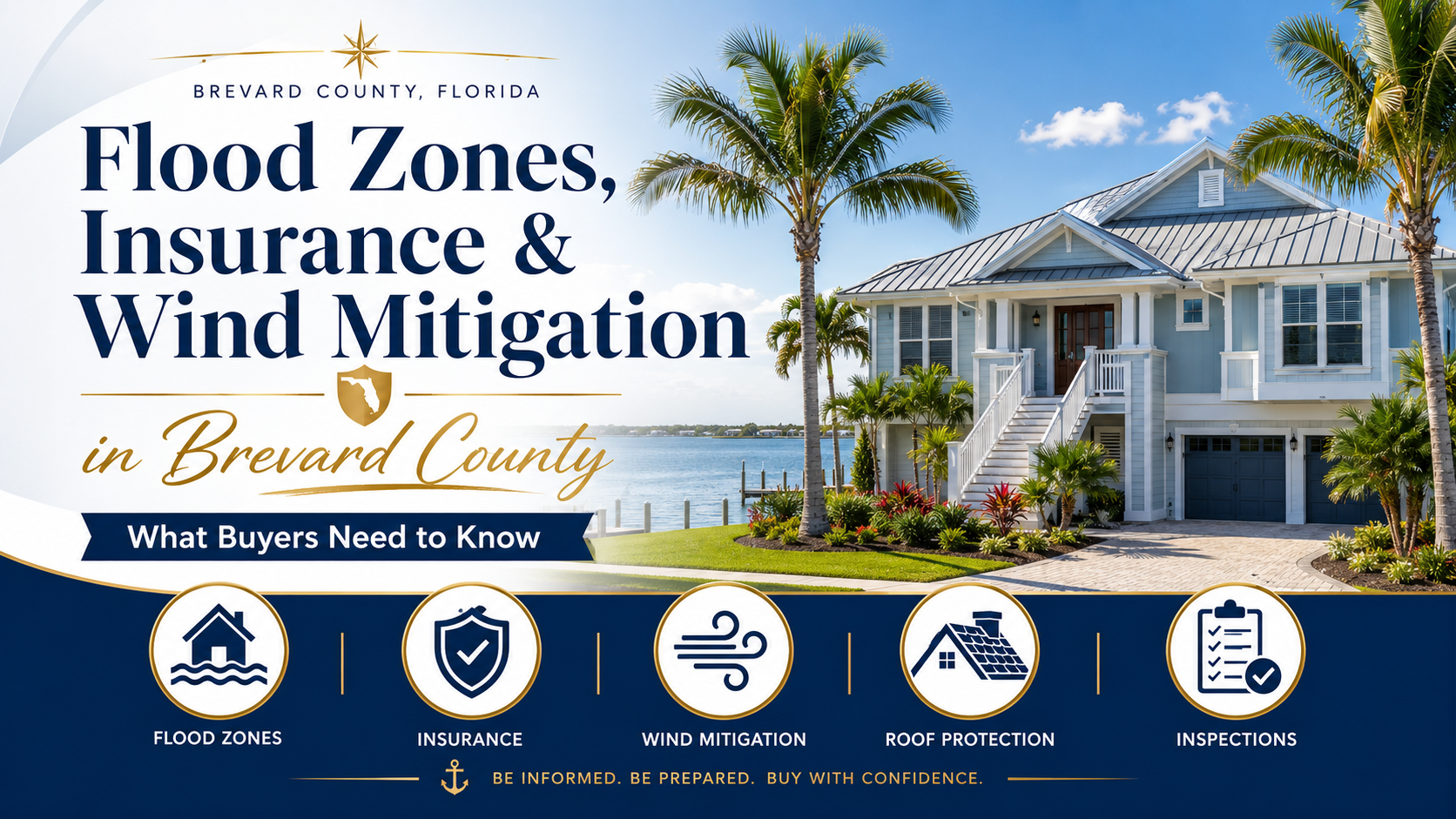
Buying a home in Brevard County means understanding more than the purchase price. Flood zones, homeowners insurance, flood insurance, roof age, and wind-mitigation features can all affect your monthly payment, closing timeline, long-term maintenance budget, and resale appeal.
The good news is that these items are manageable when buyers investigate them early. Before making an offer, review the flood zone, request insurance quotes, inspect the roof and hurricane-protection features, and make sure the home’s wind-mitigation documentation is current.
Quick Answer
Before buying a home in Brevard County, confirm the property’s flood-zone designation, obtain homeowners and flood-insurance estimates early, review hurricane deductibles, and request a current wind-mitigation report.
A home outside a high-risk flood zone may still have flood exposure, while a newer roof does not automatically mean the home qualifies for every available insurance credit. The details matter.
Why These Three Topics Matter
| Topic | Why It Matters to Buyers | Best Time to Review |
|---|---|---|
| Flood zone | Can affect lender flood-insurance requirements, future risk, and resale | Before making an offer |
| Homeowners insurance | Can significantly affect total monthly housing cost | During the inspection period |
| Wind mitigation | May improve storm protection and qualify for wind-premium credits | During the inspection period |
| Roof age and condition | Often affects insurability, pricing, and underwriting | Before or immediately after offer |
| Hurricane deductible | Determines your out-of-pocket responsibility after a named storm loss | Before binding insurance |
1. Understanding Flood Zones in Brevard County
Flood zones are FEMA map designations that identify areas with different levels of mapped flood risk. In Brevard County, buyers commonly see properties in coastal, riverfront, lagoon-front, canal-front, and inland drainage areas with varying flood-zone designations.
A flood zone does not mean a property will flood. It also does not mean a property outside a high-risk zone cannot flood. Heavy rainfall, drainage problems, storm surge, king tides, canals, lagoons, and nearby waterways can all affect a property differently.
Brevard County’s Floodplain Administration is the official local repository for FEMA Flood Insurance Rate Map panels, and FEMA’s Flood Map Service Center allows buyers to search flood-map information by address.
Flood-Zone Terms Buyers May See
| Term | What It Generally Means |
| Special Flood Hazard Area | Area FEMA maps as having higher flood risk |
| Flood Insurance Rate Map | FEMA map showing mapped flood-risk zones |
| Base Flood Elevation | The expected water elevation during a base flood event |
| Elevation Certificate | Document showing how a structure’s elevation compares to mapped flood information |
| Floodplain | Area that may be subject to flooding under certain conditions |
| Flood insurance | Separate coverage that may be required by a lender or chosen by the owner |
2. Why an Elevation Certificate Can Matter
An elevation certificate is not required for every home purchase, but it can be very helpful when comparing insurance options for properties in or near mapped flood-risk areas.
It may show the finished-floor elevation, the lowest enclosed area, the type of foundation, and how the home sits in relation to the base flood elevation. Insurance agents can use this information to better evaluate flood-risk factors and available coverage options.
For waterfront and beachside homes in areas such as Satellite Beach, Indian Harbour Beach, Indialantic, Melbourne Beach, Cocoa Beach, Cape Canaveral, Merritt Island, and parts of Palm Bay, buyers should ask whether an elevation certificate is available.
3. Flood Insurance Is Not Just a Beachside Issue
Many buyers assume flood insurance is only important for homes directly on the ocean. In reality, flood exposure can also come from the Indian River Lagoon, Banana River, canals, lakes, drainage systems, heavy rain, and stormwater backup.
Even when a lender does not require flood insurance, buyers may still choose coverage based on the property’s location, elevation, prior history, and comfort level.
Flood Due-Diligence Checklist
| Item to Review | Why It Matters |
| FEMA flood-zone designation | Helps identify mapped flood-risk information |
| Elevation certificate | May help with insurance review and risk comparison |
| Seller disclosure | Can identify known water intrusion or prior claims |
| Property survey | Helps show lot lines, drainage areas, docks, seawalls, and easements |
| Drainage conditions | Helps identify standing water, grading, or runoff concerns |
| Flood-insurance quote | Helps estimate true ownership costs before closing |
4. Get Insurance Quotes Early
Insurance should be part of your due diligence from the beginning, especially for older homes, coastal properties, waterfront homes, condos, and homes with roofs nearing the end of their useful life.
Do not wait until the last few days before closing to request quotes. Some insurers may require inspections, additional documentation, roof information, electrical details, or updated mitigation reports before they can offer coverage.
Questions to Ask Your Insurance Agent
- What is the estimated annual homeowners-insurance premium?
- Is flood insurance required by the lender?
- What is the estimated flood-insurance premium?
- What hurricane deductible applies to this policy?
- Does the home qualify for wind-mitigation credits?
- Are there age restrictions for the roof, electrical panel, plumbing, or water heater?
- Is the policy replacement-cost coverage or actual-cash-value coverage?
- Are there exclusions or coverage limits I should understand before closing?
Florida homeowners policies commonly include a separate hurricane deductible. That deductible is typically different from the standard deductible and may be calculated as a percentage of the insured value of the home.
5. What Is Wind Mitigation?
Wind mitigation refers to construction features that help reduce hurricane-related damage. A wind-mitigation inspection documents qualifying features that may make a home more resilient and may qualify for discounts on the windstorm portion of a homeowners-insurance premium.
Florida insurers are required to offer mitigation discounts or credits for qualifying hurricane-loss-mitigation features, although the actual savings depend on the insurer, the home, and the documented features.
Wind-Mitigation Features to Review
| Feature | Why It Matters |
| Roof shape | Hip roofs may qualify for different credits than gable roofs |
| Roof covering | Age, material, permit date, and condition may affect insurability |
| Roof-deck attachment | Stronger attachment can improve wind resistance |
| Roof-to-wall connection | Clips, wraps, or other connectors can affect credits |
| Secondary water resistance | May reduce water intrusion if roof covering is damaged |
| Opening protection | Impact windows, shutters, or approved panels can be important |
| Garage-door rating | Reinforced or impact-rated doors can help protect the structure |
6. A New Roof Does Not Automatically Equal Maximum Credits
A newer roof is a major advantage, but buyers should not assume that every new roof qualifies for every wind-mitigation credit.
The report depends on actual documented features, including the roof-to-wall connection, roof-deck attachment, roof shape, secondary water resistance, and protection for all openings. A home may have impact windows on the front but older non-impact windows elsewhere, which can limit available credits.
Ask for the most recent wind-mitigation report. If it is outdated, incomplete, or unavailable, it is often worth ordering a new one during the inspection period.
7. Roof Age and Condition Matter for Insurance
Roof age is one of the most important insurance questions in Florida. Insurance carriers may have different underwriting guidelines for shingle, tile, metal, and flat roofs. They may also have specific requirements based on condition, remaining useful life, visible wear, and prior repairs.
During inspections, pay attention to:
- Missing, cracked, curling, or lifted shingles
- Rusted fasteners on metal roofs
- Cracked seals around penetrations
- Soft spots or visible sagging
- Active leaks or interior staining
- Poor attic ventilation
- Improper prior repairs
- Roof permit date and transferable warranties
A roof that still “looks okay” may not meet every insurer’s underwriting standards. This is why an early insurance quote and roof review are so important.
8. Older Homes Need Extra Attention
Older Brevard County homes can offer excellent locations, mature landscaping, larger lots, and character that newer homes may not have. But older systems can affect insurability.
Buyers should carefully review electrical panels, wiring, plumbing materials, water heaters, HVAC age, roof age, windows, and hurricane protection.
Common Older-Home Insurance Questions
| System | What Buyers Should Verify |
| Roof | Age, permit date, remaining life, material, repairs |
| Electrical | Panel type, breaker condition, grounding, updates |
| Plumbing | Supply lines, drain materials, leaks, cast iron or galvanized pipe |
| HVAC | Age, condition, corrosion, maintenance history |
| Windows | Impact rating, shutter coverage, seals, condition |
| Water heater | Age, condition, leak history, installation details |
A four-point inspection may be required or helpful for older homes because it focuses on the roof, electrical, plumbing, and HVAC systems.
9. Beachside and Waterfront Homes Need an Extra Layer of Review
Homes in Satellite Beach, Indian Harbour Beach, Indialantic, Melbourne Beach, Cocoa Beach, Cape Canaveral, and waterfront areas of Merritt Island often require additional due diligence because of salt air, flood exposure, storm surge concerns, and coastal maintenance.
For beachside and waterfront properties, buyers should consider:
- Flood-zone review and insurance estimates
- Salt-air corrosion on HVAC, railings, windows, and hardware
- Roof condition and hurricane protection
- Drainage and elevation
- Seawall, dock, boat-lift, and shoreline condition
- Oceanfront or lagoon-front maintenance requirements
- Condo-master-policy details for attached properties
10. Condo Buyers Need to Review the Master Insurance Policy
For condos, the association’s master policy is a major part of the ownership picture. Buyers should review what the association insures, what the unit owner must insure, deductibles, reserves, planned repairs, special assessments, and any building-inspection requirements.
A lower monthly condo fee is not always better if reserves are limited or major repairs are expected. Review the budget, reserves, meeting minutes, insurance declaration page, rental restrictions, and any known assessment discussions before the end of your contingency period.
Smart Buyer Timeline
| When | What to Do |
| Before touring | Decide your comfort level with flood exposure, older homes, and coastal maintenance |
| Before offering | Review flood-zone information, roof age, permits, and property disclosures |
| First days of inspection period | Request homeowners and flood-insurance quotes |
| During inspections | Order general, roof, four-point, wind-mitigation, and other needed inspections |
| Before closing | Confirm insurance binder, deductibles, flood coverage, and final mitigation documentation |
| After closing | Keep reports, permits, warranties, and insurance documents organized for future resale |
Frequently Asked Questions
Does a flood zone mean I cannot buy the home?
No. Many desirable Brevard County homes are located in mapped flood zones. It simply means you should understand the property’s flood exposure, elevation, insurance requirements, and potential ownership costs before proceeding.
Is flood insurance required in Brevard County?
Flood insurance may be required by a lender if the home is located in a FEMA-designated Special Flood Hazard Area. Even when not required, some owners choose flood coverage based on the property’s location and risk tolerance.
What is a wind-mitigation inspection?
It is an inspection that documents qualifying hurricane-resistance features of a home, such as roof shape, roof connections, roof-deck attachment, secondary water resistance, and opening protection.
How much can wind mitigation save?
Savings vary by insurer, the home’s age and design, and the actual features documented. It is best to have an insurance agent quote the specific property using the current wind-mitigation report.
Do impact windows lower insurance costs?
They can help, especially when all openings are protected and the home qualifies for specific wind-mitigation credits. The actual premium impact depends on the insurer and the complete protection system.
Should I get insurance quotes before making an offer?
Yes. At minimum, request preliminary quotes as early as possible. For coastal, older, waterfront, or higher-value homes, insurance should be treated as a priority before the inspection period ends.
Final Thoughts
Flood zones, insurance, and wind mitigation should not scare buyers away from Brevard County homes. They are simply part of smart Florida homeownership.
The right approach is to investigate early, ask specific questions, compare insurance options, review inspections carefully, and understand the long-term costs before closing. That gives buyers the confidence to enjoy the benefits of living in Brevard County without being surprised later.
Thinking about buying in Brevard County? I can help you compare homes, identify flood and insurance questions early, review inspection findings, and make sure the property you choose fits both your lifestyle and long-term budget.

Join The Discussion